 Robine Studio
Tools
The fretboard with scales, modes, CAGED shapes and three-notes-per-string positions, the circle of fifths, the tuner and the metronome.
Fretboard
The fretboard shows the notes of a scale, a mode or a chord on the neck. Each note gives its name and its degree from the root, with a colour per degree.
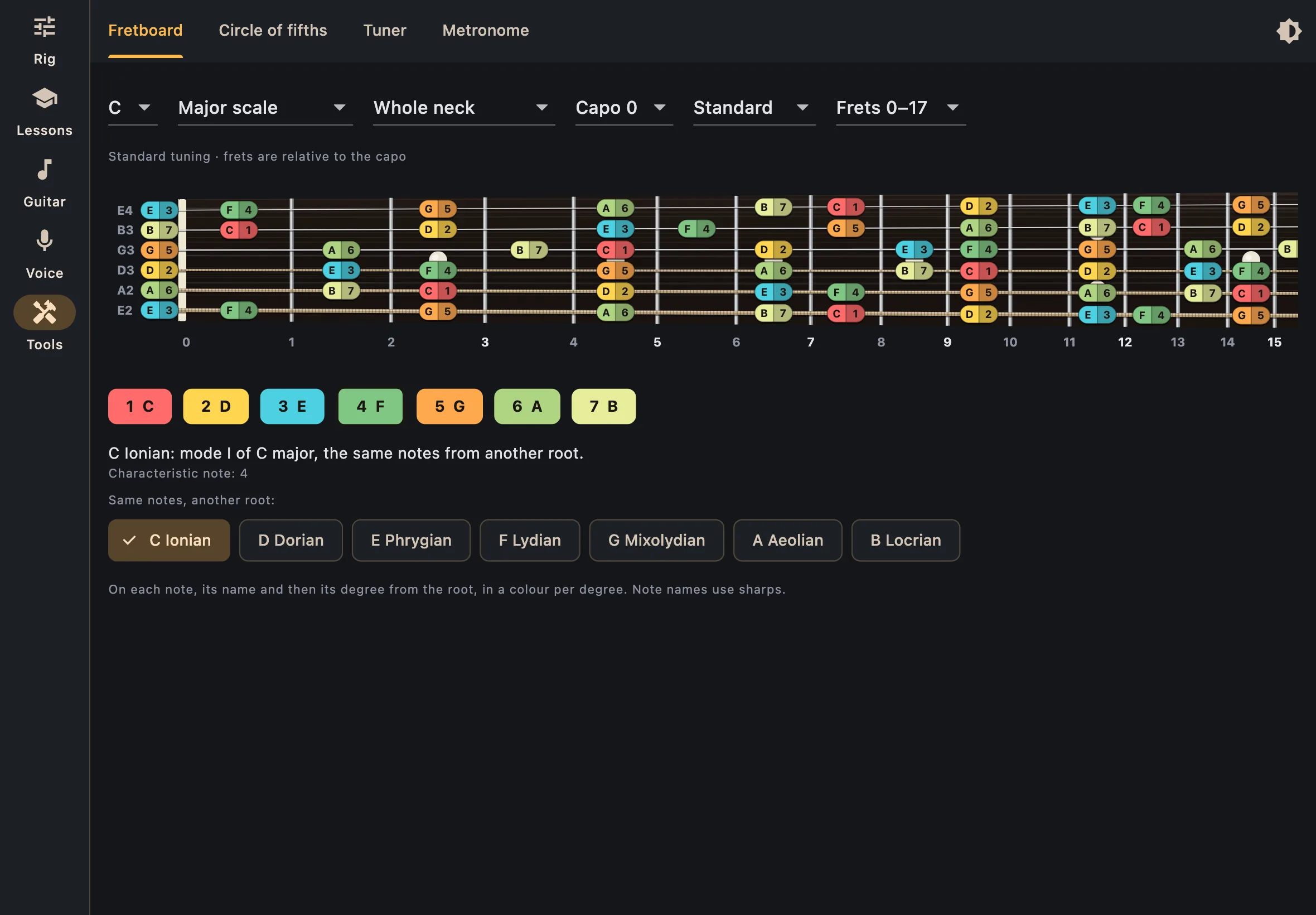
Choose, from left to right:
- the root;
- what to show: all notes, the major scale, the natural minor, the pentatonics, a major or minor triad, or a mode;
- how: the whole neck, or one position at a time;
- the capo, the tuning (standard, drop D, D standard, open G) and the frets shown (0–17 or 12–24).
Positions: CAGED and three notes per string
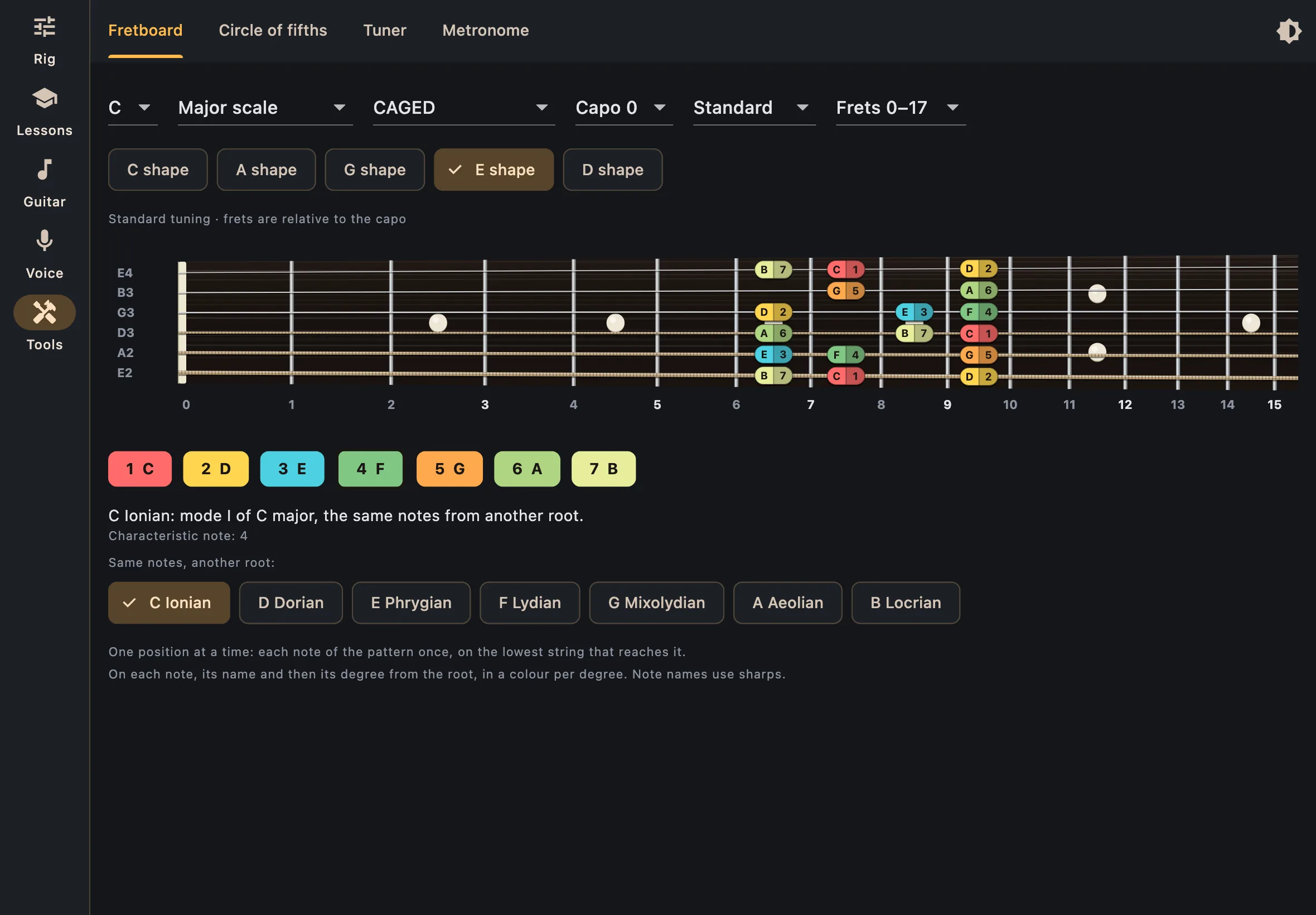
To learn a scale one position at a time, choose CAGED or 3 notes per string, then a position:
- CAGED gives five shapes, named after the chord shape of the root (C, A, G, E, D), that follow each other up the neck. It works with any scale or chord: with a pentatonic, they are its five boxes; with a triad, its arpeggios.
- 3 notes per string gives seven positions, one starting on each degree of the scale on the low string. It needs a scale of seven notes.
Each note of a position is played once, on the lowest string that reaches it.
Modes
Choose a mode (Ionian, which is the major scale, Dorian, Phrygian, Lydian, Mixolydian, Aeolian, which is the natural minor, or Locrian) and the fretboard says which major scale it comes from and on which degree: D Dorian is mode II of C major. Its characteristic note, the one that sets it apart, is outlined in the legend.
Under it, the seven modes of the same notes: tap one to keep the notes and move the root, and see how the same shapes change their colour.
Circle of fifths
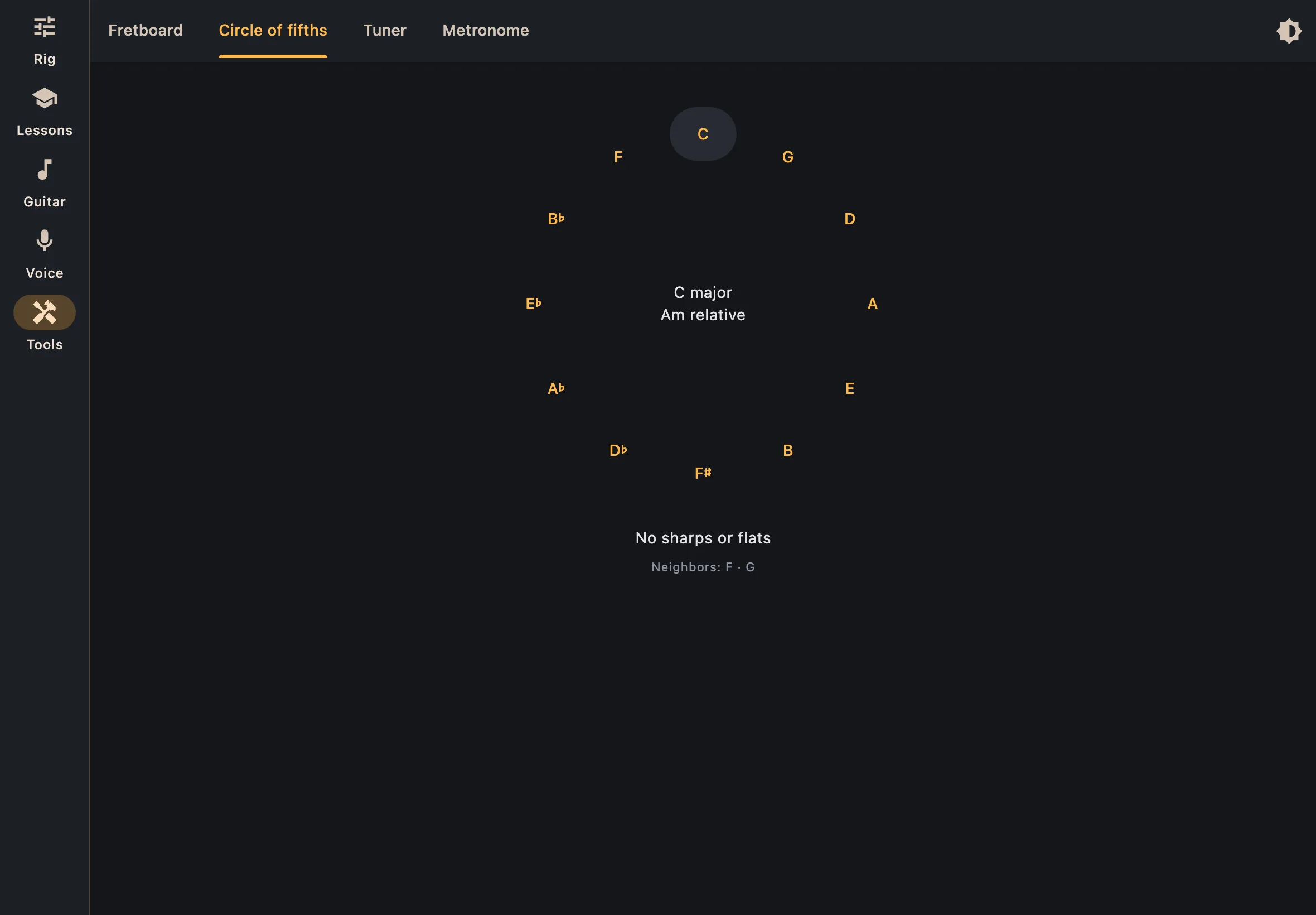
The twelve major keys and their relative minors, in fifths. Tap a key to see its signature and its neighbours.
Tuner
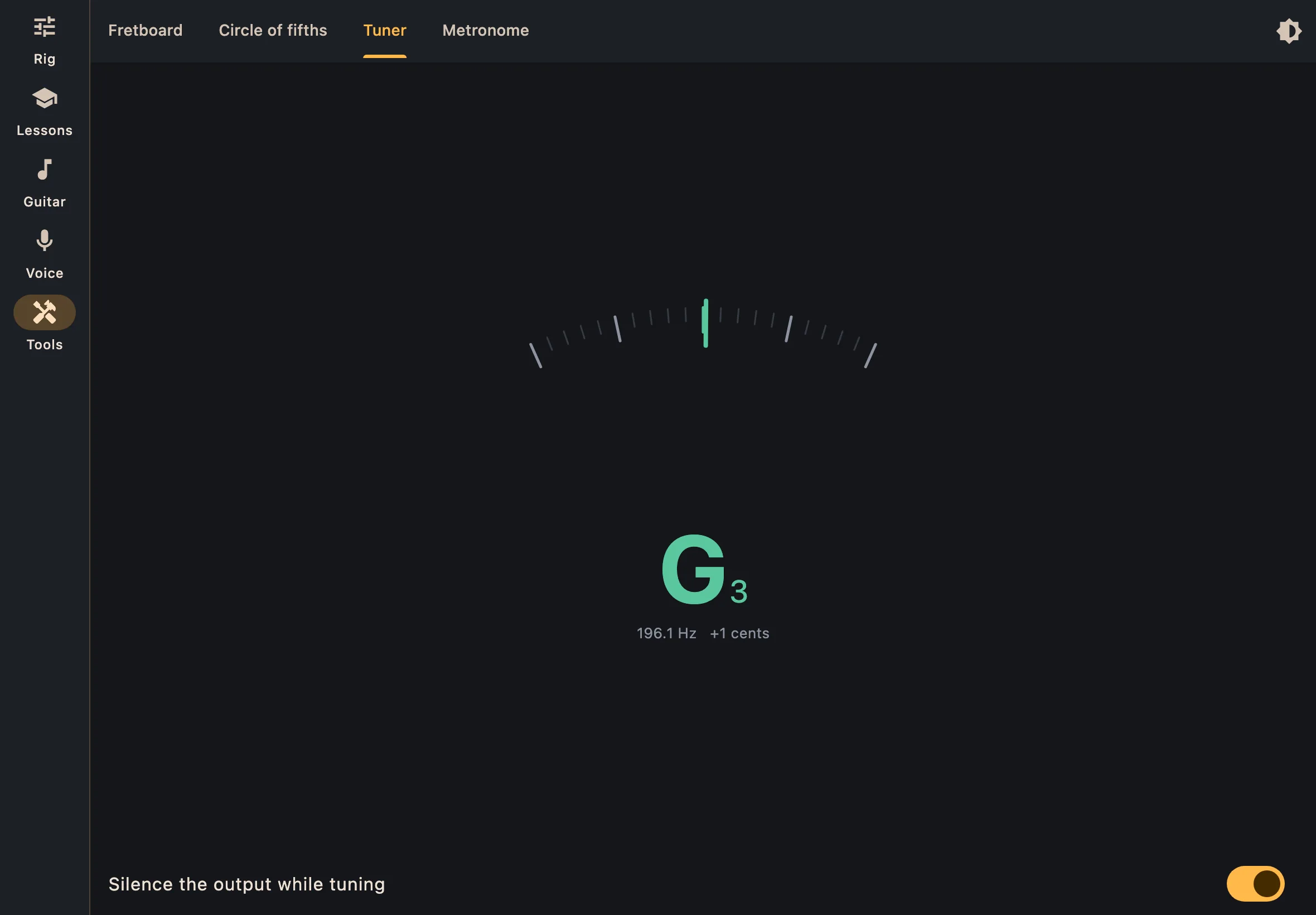
The same tuner as in the rig: the note, and how far from it you are. Turn on Silence the output while tuning to tune in silence.
Metronome
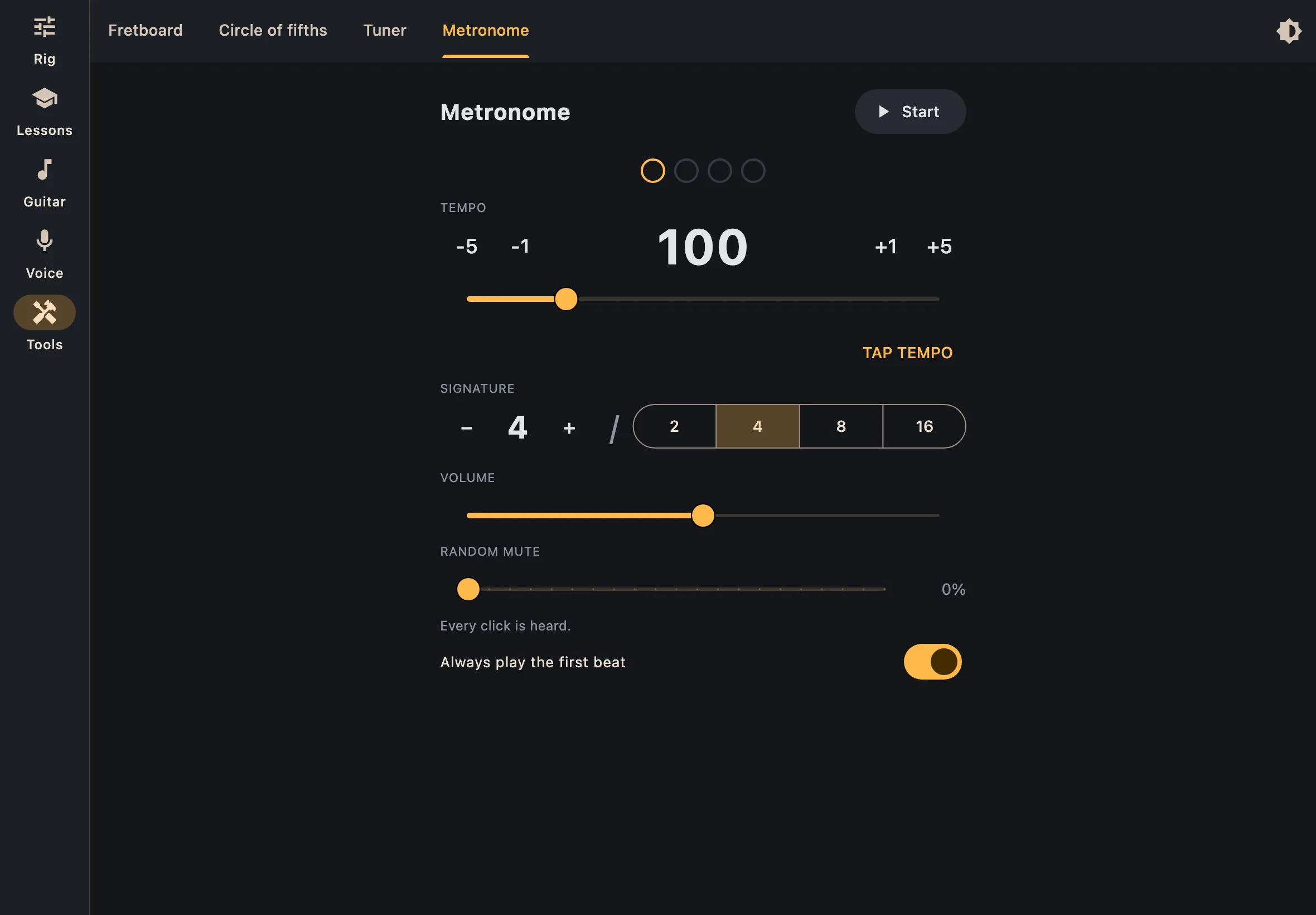
- The tempo, with steps of 1 and 5, a slider, and Tap tempo: tap the beat and the tempo follows.
- The time signature: beats per bar, and the note value of a beat.
- The volume of the click.
- Random mute leaves clicks out at random, so you learn to keep time on your own. Always play the first beat keeps the first of each bar.